Website Redesign vs New Website: Which One Makes More Sense?
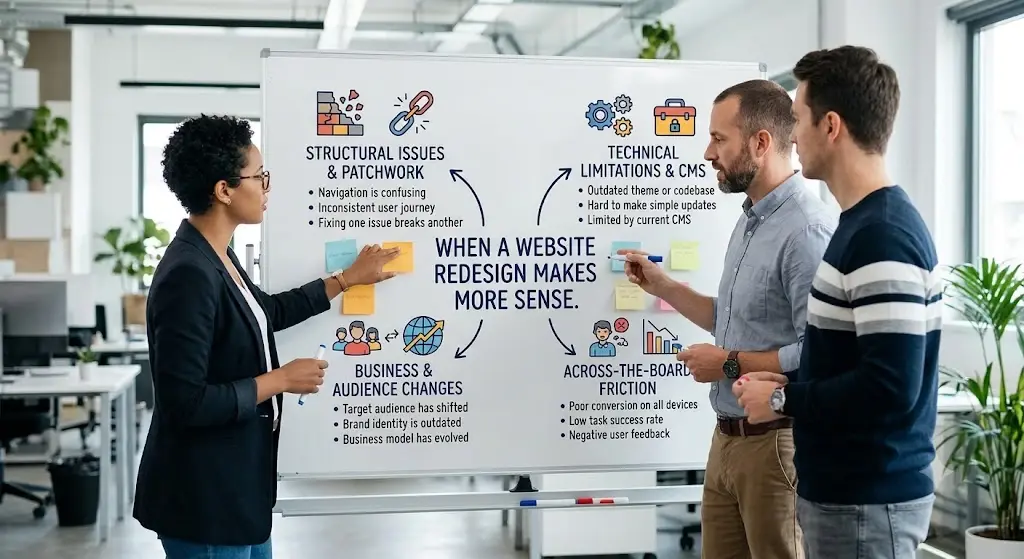
When your website no longer serves your business well, it is time to make it work for you again. It might be outdated, slow to load, or not represent the business properly. When that happens, it’s a decision between a redesign or the creation of a brand new website.
It’s not always a simple answer. There are some websites that require only structural changes and enhancements to their designs. Others have more serious problems and it is better to go for a complete rebuild in the long run. The right choice can result in wasted expense, missed opportunities and future restrictions.
In this guide, you’ll see the difference between a business website redesign and a new website and how to make a better decision for your business.
Why Businesses Start Considering Website Changes
Websites rarely become ineffective overnight. Most businesses notice small problems first. Over time, those issues begin affecting performance and lead generation.
Here are some of the most common reasons businesses start exploring website redesign or new website service.
1) Your Website Looks Outdated
Design trends change. Customer expectations change too. A website that looked modern five or six years ago may now feel outdated today. Visitors often judge credibility within seconds of arriving on a website. If the design looks old, trust can decline before visitors even read the content.
2) Leads and Enquiries Are Declining
A website should support business growth. If enquiries, bookings or sales are falling despite ongoing marketing activity, the website may be contributing to the problem.
Poor layouts, confusing navigation and weak calls to action can make it harder for visitors to take the next step. Sometimes improving website design and user experience is enough to reverse this trend.
3) Mobile Experience Feels Poor
Most website traffic now comes from mobile devices. If visitors need to zoom, scroll excessively or struggle to navigate pages, the website experience quickly becomes frustrating. Poor mobile usability often affects conversions, engagement and search visibility.
A modern website redesign often focuses heavily on mobile performance.
4) Slow Loading Speeds
Visitors expect websites to load quickly. Slow websites can increase bounce rates and reduce customer engagement. They can also affect search rankings.
While speed issues can sometimes be fixed during a business website redesign, severe performance problems may indicate the need for a completely new website.
5) Your Business Has Changed
Businesses evolve over time. New services are added. Markets change. Customer expectations shift. Some businesses even change their positioning entirely.
A website built years ago may no longer reflect the current business accurately. This is often a major reason companies choose to redesign existing website content and structure.
6) Competitors Look More Professional
Customers compare businesses constantly. If competitors have invested in modern websites, stronger branding and better user experiences, older websites can start feeling less competitive.
Many businesses begin exploring website design in UK services after noticing competitors gaining a stronger online presence.
7) Your Website Is Difficult to Update
A website should not become a burden to manage. If making simple content updates requires developer support or complicated workarounds, productivity suffers. Businesses often outgrow older systems and need a more flexible solution.
This is one of the strongest indicators that a larger website project may be necessary.
What Is a Website Redesign?
A website redesign improves the existing website while keeping much of the current foundation intact. The goal is not to start from scratch. Instead, businesses improve the parts of the website that are limiting performance, usability or appearance.
A website redesign in UK project typically focuses on improving how the website looks, functions and supports customer engagement.
What Usually Changes During a Website Redesign?
Depending on the project, a redesign may include:
- updated page layouts
- improved navigation
- stronger calls to action
- mobile optimisation
- refreshed visual design
- content restructuring
- improved user experience
- conversion-focused improvements
Many businesses choose a modern website redesign because they want better results without rebuilding everything completely.
What Usually Stays the Same?
In many redesign projects, businesses keep:
- Existing domain name
- Core website structure
- Content foundations
- CMS platform
- Existing SEO authority
- Major website functionality
This can make a website refresh more cost-effective than building a new website from the ground up.
What Is a New Website?
A new website is built from the beginning. Instead of updating the existing website, the entire project is planned, designed and developed as a new solution.
This approach gives businesses complete flexibility. It also allows outdated technology, poor structures and long-term limitations to be removed completely. Many businesses invest in a new website when incremental improvements are no longer enough.
What Changes During a New Website Project?
A new website often includes:
- Completely new design system
- Content structure
- User experience
- Page layouts
- Development framework
- Navigation architecture
- Improved functionality
- New performance standards
This approach is common when businesses require more advanced website development capabilities or future scalability.
When Businesses Typically Choose a New Website
A new website often makes sense when:
- The current website is very old
- Technology limitations exist
- Security concerns continue
- The business model has changed
- Performance problems are widespread
- Growth plans require new functionality
In these situations, investing in professional website design UK services often delivers greater long-term value than continually updating an outdated system.
Website Redesign vs New Website: Side-by-Side Comparison
| Factor | Website Redesign | New Website |
| Cost | Usually lower | Usually higher |
| Timeline | Faster completion | Longer project timeline |
| Existing Structure | Mostly retained | Completely rebuilt |
| Design Improvements | Significant | Unlimited flexibility |
| SEO Risk | Lower | Requires careful migration |
| Performance Improvements | Moderate to high | Often highest potential |
| Scalability | Depends on existing platform | Strong long-term scalability |
| Content Changes | Selective updates | Complete restructuring possible |
| Development Work | Limited | Extensive |
| Long-Term Flexibility | Moderate | High |
The right choice depends less on budget and more on the condition of the current website.
A redesign works well when the existing foundation remains strong. A new website becomes the better option when the foundation itself is creating limitations.
Signs a Website Redesign Is the Better Choice
Not every website needs replacing. Many businesses can achieve significant improvements through a well-planned business website redesign without starting over completely.
Here are some situations where a redesign often makes more sense.
1) Your Website Still Generates Leads
If visitors are still converting and the website continues generating enquiries, the foundation may already be working. In these situations, improving website design, usability and presentation can often deliver better results without rebuilding everything.
2) The Technical Foundation Is Stable
A website built on a reliable platform with manageable performance and security generally remains a strong candidate for redesign. The focus shifts toward user experience rather than redevelopment.
3) The Main Problem Is Appearance
Many businesses simply outgrow the visual design of their website. If the content, functionality and structure still perform reasonably well, a website refresh may solve most issues without requiring a completely new website.
4) Content Is Mostly Relevant
When content remains accurate and useful, businesses can often focus on:
- better layouts
- improved readability
- stronger visual hierarchy
- updated branding
This makes a redesign existing website approach far more efficient.
5) Navigation Needs Improvement
Sometimes visitors struggle because information is difficult to find. Improving navigation, menus and page structure often creates noticeable improvements in user experience and conversions without rebuilding the entire website.
6) You Need Faster Results
A redesign usually takes less time than a completely new website. Businesses looking for quicker improvements often choose website redesign services when the existing platform still supports their goals effectively.
Signs You Need a Completely New Website
A website redesign project can solve many problems, but not every website has a foundation worth keeping.
Some websites have accumulated years of technical limitations, outdated structures and performance issues. In these situations, redesigning individual pages often becomes a temporary solution rather than a long-term fix.
Here are some signs that investing in a new website may make more sense.
1) Your Website Uses Outdated Technology
Technology changes quickly. Some older websites rely on outdated systems, unsupported plugins or custom code that becomes increasingly difficult to maintain. As updates become harder and compatibility issues continue growing, businesses often spend more money fixing problems than improving the website.
A new website allows businesses to move onto a stronger and more scalable foundation.
2) Performance Problems Continue Returning
Slow loading pages, technical errors and functionality issues can usually be fixed. The concern starts when those same problems continue returning despite repeated fixes.
This often indicates deeper issues within the website architecture. In these situations, building a new website often makes more sense than continuing to fix recurring problems.
3) Your Business Has Changed Significantly
Many businesses start with one service offering and evolve over time. New services are introduced. New markets are targeted. New customer needs emerge.
If the current website was built around a completely different business model, redesigning individual pages may not be enough. A new website can create a structure that better supports the business today rather than the business that existed years ago.
4) The Website Structure Limits Growth
Some websites become difficult to expand. Adding new pages creates confusion. Navigation becomes cluttered. User journeys become difficult to manage.
A website should support future growth rather than limit it. If scalability has become a concern, a new website often provides more flexibility than trying to continuously improve website design within an outdated structure.
5) Security and Maintenance Problems Continue
Frequent security issues should never be ignored. Older websites often become harder to maintain because software updates, plugin compatibility and security patches create ongoing problems.
A modern website built using current standards can reduce many of these risks while creating a more stable platform moving forward.
6) User Experience Problems Exist Across the Entire Website
Sometimes the issue is not a single page. The issue exists everywhere. Visitors struggle to navigate. Information feels disorganised. Mobile usability is poor. Calls to action are unclear.
When user experience problems affect the entire website, a complete rebuild often delivers better results than a partial website refresh.
The Hidden Costs Businesses Often Ignore
Many businesses compare redesign and rebuild projects based only on upfront costs. The bigger question is often:
“What is the cost of doing nothing?”
An outdated website can quietly affect business performance in several ways.
Lost Leads and Enquiries
Every website has one main job. Helping visitors take action. If customers struggle to find information, trust the business or complete enquiries, opportunities are lost.
Many businesses focus on redesign costs while overlooking the value of enquiries they are already missing.
Lower Search Visibility
Search engines continue evolving. Older websites often struggle with:
- Mobile usability
- Page speed
- Technical SEO
- User experience
Over time, this can reduce visibility and organic traffic. Investing in a business website redesign or a new website can often improve search performance when these issues are addressed properly.
Reduced Customer Trust
Customers form opinions quickly. An outdated website can create doubts about professionalism, reliability and credibility. Even when products or services remain excellent, the website may send a different message.
Trust plays a major role in purchasing decisions, especially in competitive industries.
Higher Marketing Costs
Many businesses increase advertising budgets when conversions decline. The real issue may be the website. Driving more traffic to an underperforming website rarely solves the problem. Improving the website experience often creates better returns from existing marketing activity.
Internal Frustration
Employees feel website limitations too. Simple updates take longer. Content changes become frustrating. New campaigns require workarounds. Over time, website limitations create unnecessary operational challenges throughout the business.
How Website Decisions Affect SEO
SEO is one of the most important factors to consider before making major website changes. A successful website redesign UK project can improve rankings. A poorly managed project can cause traffic losses. Understanding the difference is important.
SEO Benefits of a Website Redesign
A redesign can improve:
- Page speed
- Mobile usability
- Content structure
- Internal linking
- User experience
Because much of the existing website remains intact, redesign projects often carry lower SEO risk when handled correctly.
SEO Benefits of a New Website
A new website creates opportunities to fix deeper SEO problems.
Businesses can improve:
- Website architecture
- Navigation
- Technical SEO
- Content organisation
- Page hierarchy
This creates a stronger long-term foundation for search visibility.
Common SEO Mistakes During Website Changes
Many businesses lose rankings because of avoidable mistakes.
Common examples include:
- Deleting important pages
- Changing URLs without redirects
- Removing valuable content
- Losing metadata
- Breaking internal links
These issues can affect traffic regardless of whether the project involves a redesign or a new website.
How to Protect Existing Rankings
Before launching any website project:
- Audit existing pages
- Preserve valuable content
- Create redirect plans
- Maintain metadata
- Monitor rankings after launch
SEO should be considered from the beginning of the project rather than after the website goes live.
How Website Decisions Affect Conversions
Traffic alone does not grow a business. Visitors need clear reasons to take action. A website that attracts traffic but struggles to convert visitors often needs more than visual improvements.
Navigation and User Flow
Visitors should be able to find information quickly. Complicated navigation creates frustration and increases drop-off rates. Both website redesign projects and new websites often improve conversion performance by creating clearer user journeys.
Mobile Experience
Many businesses now receive most of their traffic through mobile devices. A poor mobile experience can reduce enquiries, bookings and sales. Modern websites place much greater emphasis on mobile usability than older designs.
Page Speed
Speed influences user behaviour. Visitors are less likely to stay on websites that load slowly. Faster websites generally create better engagement and stronger conversion opportunities.
Call-to-Action Placement
Many older websites hide important actions. Contact forms, enquiry buttons and service information should be easy to find.Small improvements to call-to-action placement can often create noticeable conversion gains.
Trust Signals
Visitors look for reassurance before making decisions.
Examples include:
- testimonials
- reviews
- case studies
- certifications
- client logos
Modern website design projects often improve trust by presenting these elements more effectively.
Content Structure
Visitors rarely read websites word-for-word. They scan. Clear headings, organised layouts and easy-to-read content help visitors find information faster and make decisions more confidently.
Cost Comparison: Website Redesign vs New Website
Cost is often one of the biggest factors when comparing options. However, focusing only on project price can sometimes lead to the wrong decision.
What Influences Website Redesign Costs?
A business website redesign cost usually depends on:
- Number of pages
- Design complexity
- Content updates
- UX improvements
- Functionality changes
- SEO requirements
Projects that keep the existing structure often require less development work.
What Influences New Website Costs?
A new website usually involves:
- Planning
- Strategy
- Design
- Development
- Content migration
- Testing
- Launch support
The investment is often higher because everything is built from the beginning.
Which Option Delivers Better Long-Term ROI?
The answer depends on the website. A redesign delivers strong value when the foundation remains healthy. A new website often delivers better ROI when technical limitations, performance problems and growth restrictions already exist.
The goal should never be choosing the cheaper option. The goal should be choosing the option that supports the business effectively over the next several years.
Questions to Ask Before Making a Decision
Before investing in a website redesign project or a completely new website, it helps to step back and assess the current situation carefully. Many businesses rush into website projects without understanding the actual problem. As a result, they spend money fixing the wrong issues.
Ask yourself the following questions:
Is the Website Still Generating Enquiries?
If the website continues generating leads consistently, the foundation may still be working. In many cases, improving website design and user experience may be enough.
Is the Technology Still Reliable?
Websites should be easy to maintain, update and expand. If technical issues keep returning, investing in a new website may provide better value over time.
Is the Content Still Relevant?
If most pages remain accurate and useful, a website refresh or redesign may be sufficient. However, if services, products and business goals have changed significantly, a new website may be the better option.
Does the Website Support Future Growth?
A website should support where the business is going, not where it has been. Consider whether the current website can support future services, campaigns and expansion plans.
Is the Mobile Experience Strong?
Mobile traffic continues growing every year. If the website struggles on smartphones and tablets, improvements should become a priority.
Can Website Changes Be Managed Easily?
Simple updates should not feel complicated. If simple website updates feel difficult or time-consuming, the current platform may be slowing down your workflow.
Still Not Sure Which Option Is Right?
Many businesses sit somewhere in the middle. The website has some strengths but also several limitations. This is where a professional website review becomes valuable. An experienced team can identify what should be retained, improved or replaced before major investment decisions are made.
Real-World Examples
Looking at practical examples often makes the decision easier.
Example 1: Service Business That Needed a Website Redesign
A local service company had a website that was still generating enquiries.
The main problems included:
- Outdated design
- Poor mobile experience
- Confusing navigation
- Weak calls to action
The platform remained stable and the content was still relevant. Instead of rebuilding the entire website, the business chose a website redesign project.
The redesign improved:
- Mobile usability
- Page layouts
- Visual presentation
- Enquiry pathways
Because the foundation remained strong, a redesign delivered the improvements needed without the cost of a full rebuild.
Example 2: Growing Business That Needed a New Website
A growing company had expanded significantly since launching its original website. New services had been added. Target customers had changed. The website structure no longer reflected the business accurately.
The company also faced:
- Performance issues
- Difficult content management
- Outdated technology
Rather than repeatedly updating an unsuitable system, the business invested in a completely new website.
The new website provided:
- Improved scalability
- Stronger user experience
- Better content organisation
- Greater flexibility for future growth
Example 3: E-Commerce Business Facing Technical Limitations
An online store had undergone multiple redesigns over several years. Despite the updates, problems continued.
The website struggled with:
- Slow loading speeds
- Outdated plugins
- Checkout issues
- Maintenance challenges
The business initially considered another website refresh. However, a technical review showed that the platform itself was creating limitations.
A new website ultimately provided a more reliable and scalable solution.
Final Thoughts
Choosing between a website redesign project and a completely new website is not always about budget. It is about understanding the condition of the current website and the goals of the business.
A business website redesign can be highly effective when the foundation remains strong. It allows businesses to improve website design, modernise the user experience and update branding without rebuilding everything.
A new website becomes the better option when technology, performance, structure and scalability issues continue limiting growth. The most successful website projects solve business problems rather than simply changing appearances.
At Picasso Design, we help businesses understand what their website actually needs. Before making a decision, our team assesses the current website honestly. Identify what is working, what is creating limitations and what the business needs over the next few years.
The right choice is the one that supports long-term growth, improves customer experience and creates a stronger online presence moving forward.
Frequently Asked Questions
Is it better to redesign a website or build a new one?
The right choice depends on how well the current website supports your business today. A website redesign UK project often works well when the foundation remains strong. A new website is usually better when major technical, performance or structural issues exist.
How often should a business redesign its website?
Most businesses review their websites every few years. However, the right timing depends on performance, branding, customer expectations and business growth.
Will a website redesign affect SEO?
A properly managed website redesign UK project can improve SEO. Problems usually occur when redirects, content and technical SEO elements are ignored during the process.
How do I know if my website is outdated?
Common signs include outdated design, slow loading speeds, poor mobile usability, declining enquiries and difficulty updating content.
Can I redesign my website without changing content?
Yes. Many redesign projects focus mainly on improving layouts, navigation, branding and user experience while keeping most content intact.
How long does a website redesign take?
Timelines vary depending on website size, complexity and project requirements. Smaller redesign projects are usually completed faster than full website rebuilds.
Is a new website worth the investment?
A new website can deliver significant long-term value when existing technology, performance limitations and structural issues continue affecting business growth.
What are the signs I need a business website redesign?
Common signs include outdated design, inconsistent branding, poor mobile experience, confusing navigation and lower conversion rates despite ongoing marketing activity.